SD Holman’s Pas-à-pas; not intent on arriving

Pas-à-pas; not intent on arriving

A new photo-based exhibition by SD Holman
The exhibition runs Apr 1 – Jun 2, 2023
SUM gallery open to the public Tue-Sat, 12 to 6pm
Opening reception (artist in attendance): Apr 1, 5 to 7pm
Live musical performances from Rachel Kiyo Iwaasa: Apr 19 at 12pm, May 13 at 5pm, May 19 at 5pm, June 2 at 5pm

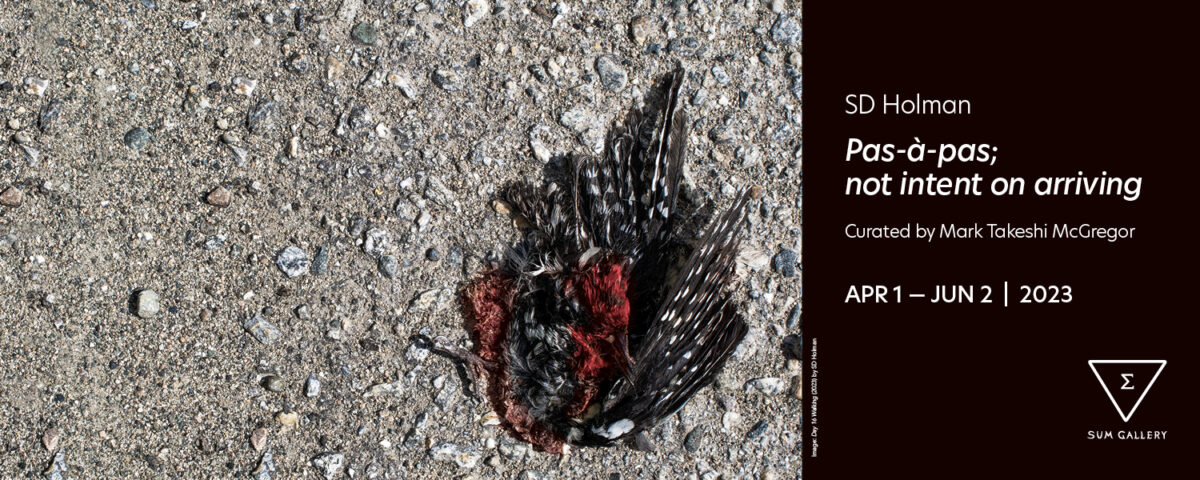
Pas-à-pas; not intent on arriving is a new photo-based multidisciplinary meditation on mourning & memory by artist SD Holman, on view at SUM gallery April 1 to June 2. Pas-à-pas; not intent on arriving (pilgrimage variations) derives from Holman’s walk across Canada following the death of their wife, Catherine White Holman. This exhibit engages artist and writer Persimmon Blackbridge, who works with words from Holman’s travel journal; and using Bach’s Goldberg Variations as an organizing principle, Holman collaborates with pianist Rachel Kiyo Iwaasa, who performs at the opening and periodically during the exhibition run.

I needed to walk; walk out my door & keep walking. I don’t like walking. You died in a plane crash. I couldn’t make sense of it. I walked for 3 months / 2700 km. I took a little G11 (not my pro camera or 4×5). I made 8,000 images—99 videos—30,000 words. These are some of them.

There is no arc to this story. I did not come out of it healed.

We all grieve. I later learned that the grieving often go on walking pilgrimages. Walk. Breathe. Think. Don’t think. Circle. Repeat. Step. By step. Try to change the outcome as you move over unfamiliar terrain. Different and the same. No epic Canadian landscapes here, instead tiny human steps cycling endlessly in an intimate vista.

SD Holman

Variations are like a voyage. But … that voyage does not lead through the infinitude of the exterior world … The voyage of variations leads into the other infinitude, into the infinite diversity of the interior world hidden in all things … We know we cannot embrace the universe with its suns and stars. Much more unbearable is to be condemned to lack that other infinitude, that infinitude near at hand, within reach… we all lose in whatever we do, because if it is perfection we are after, we must go to the heart of the matter, and we can never quite reach it… there is nothing more unbearable than lacking the being we loved, those…measures and the interior world of their infinitude of possibilities. —

Milan Kundera

About SD Holman sdholman.com

SD Holman is an award-winning artist and curator born in Hollywood, California. Described as “visionary” by curator/scholar Jonathan Katz, Holman is a graduate of ECUAD Vancouver Canada, laureate of the YWCA Women of Distinction Award, and Founding Artistic Director Emeritus of the multidisciplinary QAF + SUM gallery. Defining as a participant observer employing subjective conceptual documentary practice, Holman’s approach to photography is conflicted and perverse. Holman’s work deals in paradox: the cognitive dissonance between estrangement and recognition, aversion and attraction, harshness and beauty, bravura and restraint, outrageousness and subtlety, expressionism and classicism. Holman embraces Indeterminacy to open artistic practice to the random and radically break from tradition, convention, and habit.

Holman’s work has exhibited internationally including at Wellesley College, Amherst College, CLGA ArQuives (Toronto), the Advocate Gallery (Los Angeles), the Soady-Campbell Gallery (New York), the San Francisco Public Library, On Main Gallery, The Helen Pitt International Gallery, Charles H. Scott, Exposure, Gallery Gachet, the Roundhouse, Vancouver East Cultural Centre, Artropolis, and Fotobase Galleries (Vancouver). Holman’s portrait project BUTCH: Not like the other girls toured North America and is in its second print edition, published by Caitlin Press, Dagger Editions. Studio Q, Holman’s notorious DTES Art Salon in Vancouver’s Chinatown, was featured in Secrets of the City (1st edition).

About Rachel Kiyo Iwaasa iwaasa.com

Hailed in the press as a “keyboard virtuoso and avant-garde muse” (Georgia Straight) whose “emotional intensity” transforms music “from notes on a page to a stunning work of art” (Victoria Times Colonist), RACHEL KIYO IWAASA is recognized among Canada’s foremost contemporary music pianists. Rachel’s reputation for fearless performative risk has drawn many of Canada’s most notable composers to write for her, including Hildegard Westerkamp, Rodney Sharman, Jocelyn Morlock, Nicole Lizée, Farshid Samandari, Emily Doolittle, Jeffrey Ryan and Jordan Nobles. One half of the acclaimed contemporary flute/piano duo Tiresias with Mark Takeshi McGregor, Rachel has also performed with Yannick Nézet-Séguin, Judith Forst, the Bozzini Quartet, Heather Pawsey, Gabriel Kahane, Caroline Shaw, and Richard Reed Parry of Arcade Fire. Rachel’s debut CD, Cosmophony, has been praised as “brilliant” and “unforgettable” (Vancouver Sun) and for “the passion, intensity and the nuanced playing she’s acclaimed for… she manages to instill a sense of dynamic tension and pull to every note” (The Province).

Read the press release for Pas-à-pas; not intent on arriving.
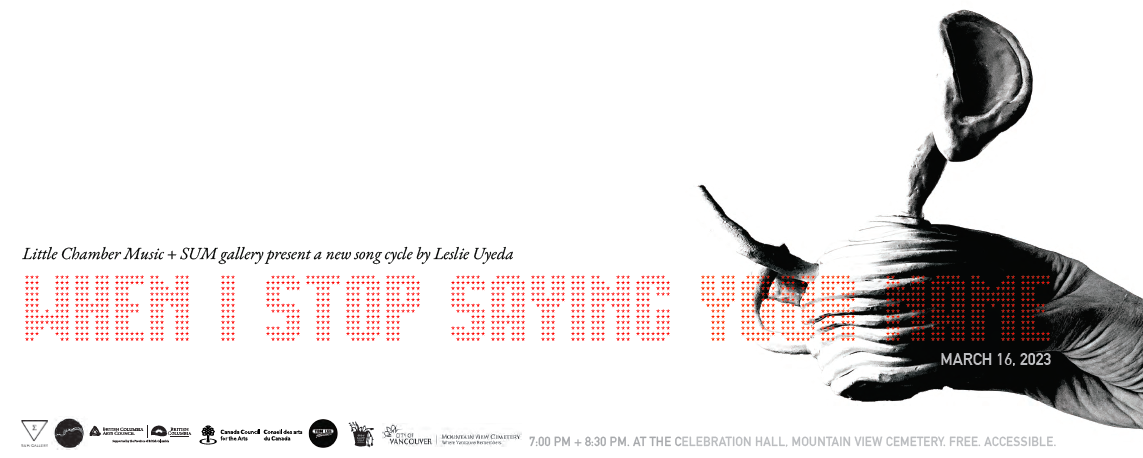
When I Stop Saying Your Name – Five Songs of Grief and Grieving

SUM gallery + Little Chamber Music present:
When I Stop Saying Your Name – Five Songs of Grief and Grieving

World premiere of new works by Leslie Uyeda
Featuring Krisztina Szabó, mezzo-soprano
Poetry reading by Lorna Crozier

Thursday, March 16
Two showtimes: 7 pm & 8:30 pm (each performance approx. 45 min)
Celebration Hall at Mountain View Cemetery (5455 Fraser St.)

Free admission

On March 16, we return to Mountain View Cemetery in partnership with our friends at Little Chamber Music to present a new song cycle by Vancouver composer Leslie Uyeda. Featuring acclaimed mezzo-soprano Krisztina Szabó, poetry by Lorna Crozier (OC), and a chamber ensemble of Vancouver’s finest, When I Stop Saying Your Name – Five Songs of Grief and Grieving will be presented twice in the same evening, alongside readings by Crozier and the premiere of a new instrumental work by Uyeda, Grief Lies Onward.

The Celebration Hall at Mountain View Cemetery is the perfect location for this musical examination of the difficult process of grief and grieving. 

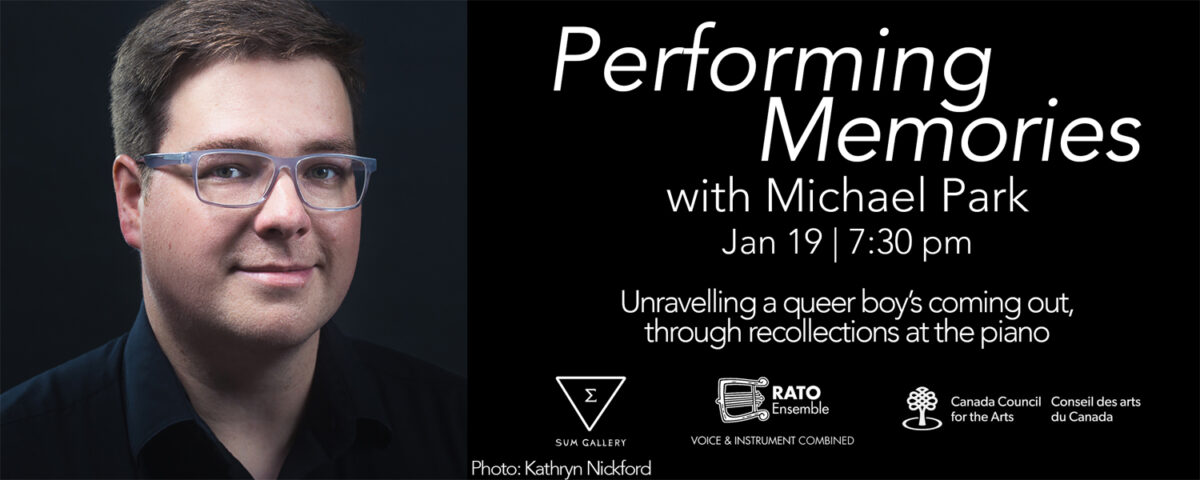
Performing Memories with pianist Michael Park

Performing Memories with Michael Park

Unravelling a queer boy’s coming out, through recollections at the piano
Co-presented by Erato Ensemble Solo Series and Queer Arts Festival + SUM gallery
Jan 19, 7:30 pm
Tickets: $25 regular admission, $15 concession (plus fees), free for students & First Nations patrons

Performing Memories is a 35-minute solo piece blending speech and piano, written by Michael Park during the pandemic. In recounting the first moment he looked back at objects from his past, the narrator takes the audience on a journey of self-discovery through themes of isolation, shame, fear and death; but also joy, love, exploration and belonging. The performance includes works by composers Cecilia Livingston, Edward Grieg, and Richard Greig. Park has collaborated with director Esteban Guti to create a film version of the piece incorporating performance footage, dramatic reenactment, and illustration/animation by Héctor Rivera. This event features the world premiere screening of the Performing Memories film.

This project was made possible by the generous support of the BC Arts Council and Canadian Council for the Arts.

ABOUT Michael Park
Michael Park (he/they) is a pianist and composer with a keen interest in speech, humour, and improvisation. His aim is to give audiences an experience beyond the realm of traditional concert-going.

Michael is a passionate champion of new music. He’s performed dozens a of B.C. premieres as resident pianist with Vancouver’s Erato Ensemble, and supported the creation of more than 100 world premieres as founder and co-director of Art Song Lab, an innovative program that teams composers, poets, and world-class performers.

For more than a decade, Michael has collaborated with dancers, choreographers, and companies including Winnipeg’s Contemporary Dancers, the Royal Winnipeg Ballet, and Ballet BC. Taking inspiration from the movement style at hand, Michael has developed a fluency in improvisation that has been praised by dancers and teachers alike.

Michael’s own compositions have been performed in Vancouver at the VSO’s Jean Coulthard Reading Session, Sonic Boom Music Festival, Songfire Festival of Song, Queer Arts Festival, and Music on Main. His music has also been performed across North America, with notable premieres in Winnipeg, Boston, and New York.
www.michaelpark.ca

Salón Silicón: Senos de Hombre

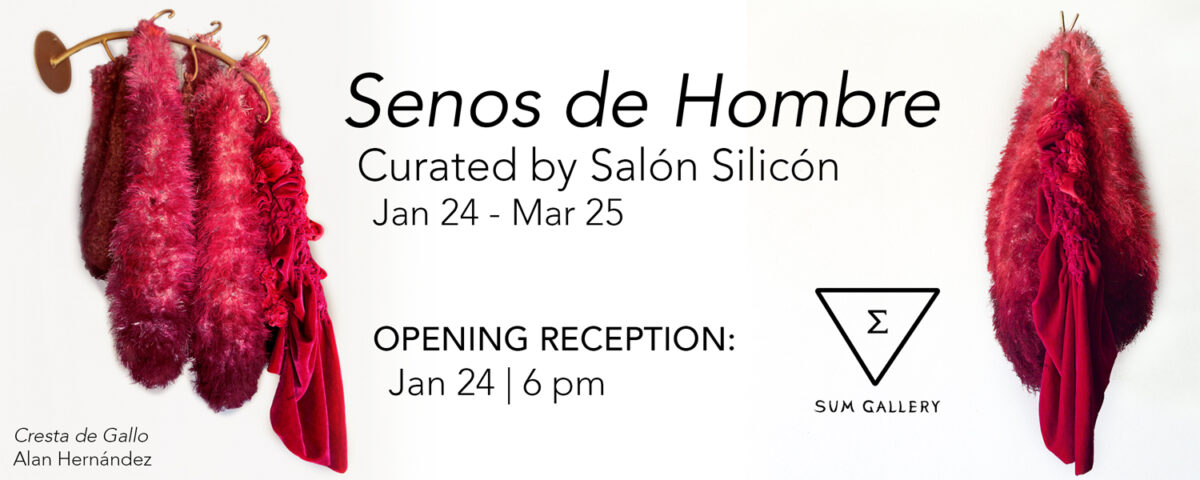
Senos de Hombre
Curated by Mexico City’s Salón Silicón: Olga Rodríguez, Romeo Gómez López and Laos Salazar


Exhibition runs Jan 24 – Mar 25, 2023
The exhibit is open to public drop ins Tue-Sat, 12 to 6pm
Opening reception (curators in attendance): Jan 24, 6 to 8pm | SOLD OUT
Silicone dildo workshop: Jan 25 – Jan 27 | SOLD OUT

Named after a common and deliberate misreading of the Spanish song “Que Bello,” Senos de Hombre or “man tits” is a group exhibition curated by Olga Rodríguez, Romeo Gómez López and Laos Salazar of Mexico City’s Salón Silicón gallery. The original lyrics of  the song: “Qué bellos son tus celos de hombre/how beautiful your man’s jealousy is” proves problematic for Rodríguez, as there is “nothing cute about jealousy, especially in a context where femicide is common and people are harmed just because of this ‘feeling’ in a man.” A common and humorous queering or “fix” for this line involves replacing the word “celos” with “senos”— the lyric now becoming: “how beautiful your man’s tits are.” With the change of one word, the song transforms from a praising of toxic masculinity, into a declaration of body positivity, posing the questions: What are man tits? How are body parts assigned gender? Senos de Hombre starts a conversation on how common assumptions of our bodies require some queering up.

Featuring work from several artists based in and around Mexico City including Romeo Gómez López, Sandra Blow, Alan Hernández, and Karl Frías García, Senos de Hombre creates a portrait of how non-binary and trans identities survive—and thrive—against a backdrop of colonialism, Catholicism, and cultural machismo. Explored through images, sculpture, and an adult-oriented workshop series, Senos de Hombre ultimately asks: “What makes a Queer body?”

Senos de Hombre is generously sponsored by The Parachute Fund.
Senos de Hombre is generously sponsored by the Deux Mille Foundation.


Read the press release for Senos de HombreEnglish/Español.

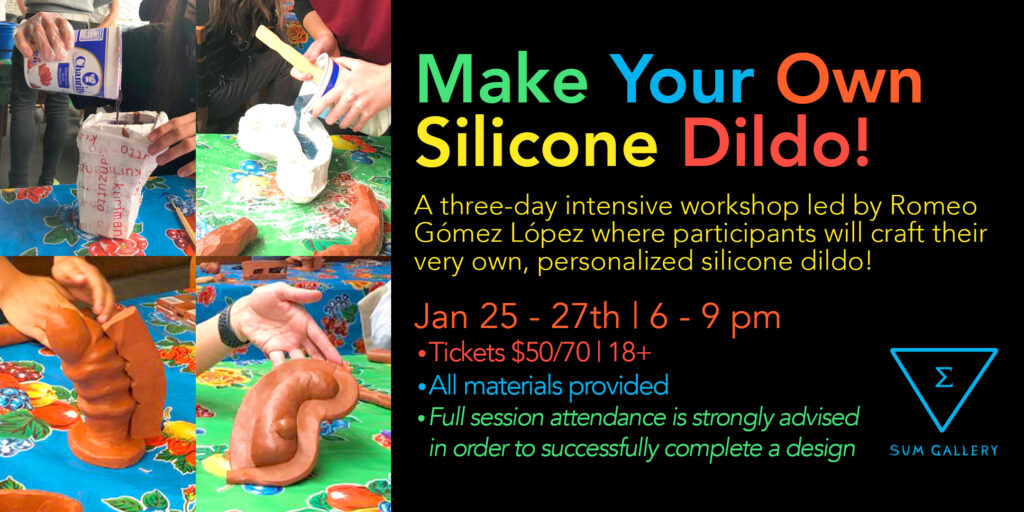
Workshop: Make Your Own Silicone Dildo

Three-day workshop facilitated by artist Romeo Gómez López
Artists concession $50, regular admission $70
Jan 25 – Jan 27, 6 to 9pm | SOLD OUT

Dildos are an instrument of sex, but also hold the power of deconstruction. By thinking that “all is dildo” as Paul B. Preciado suggests in his countersexual manifesto, we are freed in many ways from the tyranny of penises, changing the way our bodies experience proximity and pleasure. Dildos extend the plasticity of our bodies: “Anything can become a dildo. All is dildo. Even the penis.” This argument opens up the promises of queerness: refabricating our bodies and validating off-centre desires, ultimately allowing ourselves to think and fuck differently.

Over the course of three days, contemporary artist and sculptor Romeo Gómez López will introduce participants to the history of the dildo before facilitating the process of creating a dildo of their own imagining using a casting method with clay, plaster and high-grade skin safe silicone. 

All materials will be provided. Participants will be asked to prepare a design in advance to improve success and ensure their place in the workshop. Space is limited and participants must commit to all three days of the workshop in order to complete the work required to construct their dildo. Each workshop will be approximately 3 hours in length.

About Salón Silicón

Founded in 2017 by Olga Rodríguez, Romeo Gómez López and Laos Salazar, Salón Silicón is a gallery based in Mexico City, dedicated to promoting the work of women artists, queers and/or members of the LGBTI+ community. The gallery seeks to be a meeting point for different expressions, languages ​​and people. Olga Rodríguez is the gallery owner with experience in the production and marketing of contemporary art. She worked from 2008-2013 at the Juana de Aizpuru gallery in Madrid, and from 2015-2021 as manager of the Damián Ortega studio and workshop. Romeo Gómez López is a visual artist who works with alternate and nightmarish worlds contained in dioramas, sex shows with puppets and toys, which represent a resistance to the expectation of compulsory heterosexuality with a personal vision that is nurtured by humor and a pornographic imagination. Laos Salazar is an independent artist and curator who works on queer subjectivity and the construction of homosexual masculinity.

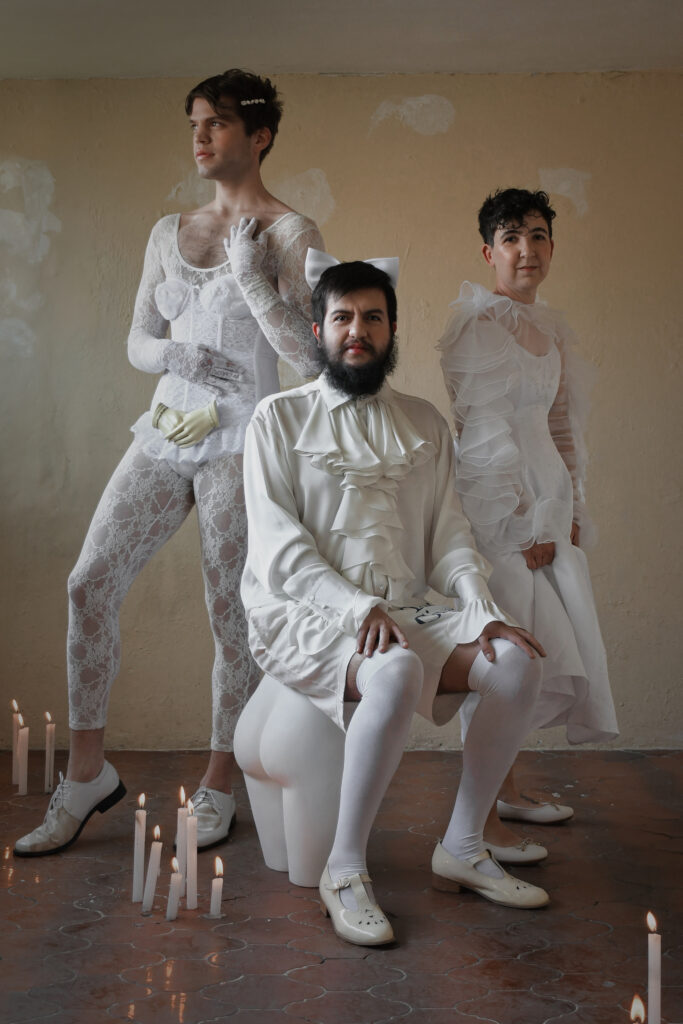
Senos de Hombre curators, from left to right: Romeo Gómez López, Laos Salazar and Olga Rodríguez of Salón Silicón. Photo by Jorge Gonzalez.

Le clown cathartique de Vivek Shraya

 Radio-Canada | April 2, 2021

[Vivek Shraya] est une artiste canadienne très importante, son oeuvre comprend la musique, la littérature l’art visuel, le film, le théâtre, même si elle est sûrement plus connue en tant qu’écrivaine » énumère la co-fondatrice de la galerie SUM et du Queer Art Festival, Rachel Kiyo Iwaasa.

Du 2 au 30 avril 2021, l’exposition photographique Trauma Clown de l’artiste multidisciplinaire Vivek Shraya est présentée à la Galerie SUM, dans le cadre du Capture Photography Festival 2021 à Vancouver.

« Pour les gens qui suivent l’art LGBTQ+ au Canada, je dirais qu’elle est l’une des artistes les plus connues. »—  Rachel Kiyo Iwaasa, co-fondatrice de la galerie SUM et du Queer Art Festival

C’est une artiste avec beaucoup de choses à dire, ses oeuvres sont très provocantes, estime la co-fondatrice du Queer Art Festival. Elle ajoute que Vivek Shraya n’a pas peur de la controverse.

Avec Trauma Clown, l’artiste cherche à connaître la cause de la popularité, du succès des artistes LGBTQ+ quand ils exposent leurs traumatismes.

Click here to listen to the original radio interview in full.

Vivek Shraya’s Trauma Clown photo series probes the commodification of personal pain

Stir Vancouver | April 1, 2021

SUM Gallery presents Trauma Clownto July 1. Opening-night receptions April 1 and 2 are sold out; an online artist talk April 3 at 3 pm is still taking registration. Advance appointments are required to view the exhibition; you can book visits here. Find COVID-19 safety guidelines here.

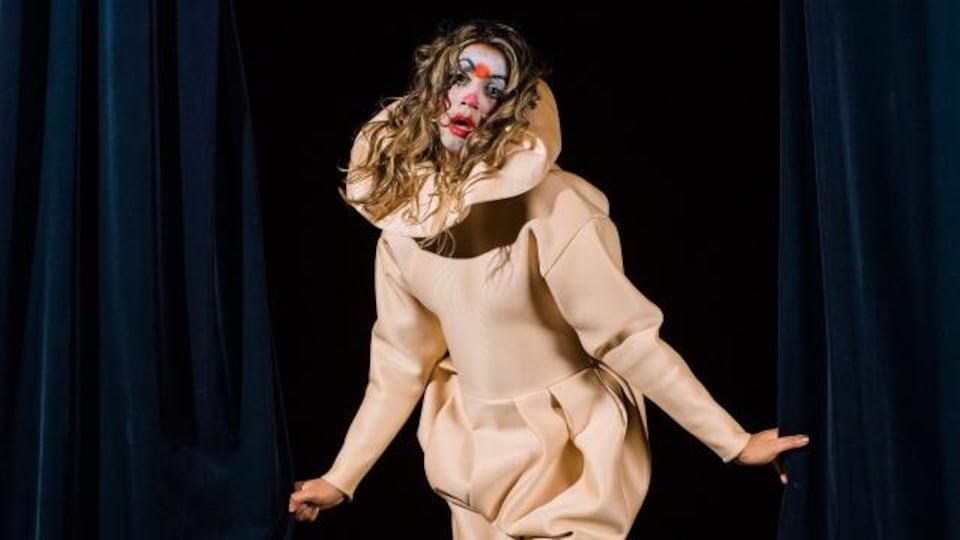
SATIRE AND SUFFERING come together in a new self-portrait series by visual artist, author, and musician Vivek Shraya.

Meant to be viewed in order in the new show Trauma Clown at the SUM Gallery, the photographs shot by Zachary Ayotte track Shraya’s gradual rise, as a trans woman of colour, to acclaim—and the cost of that rise. The exhibit is part of the 2021 Capture Photography Festival Selected Exhibition Program.

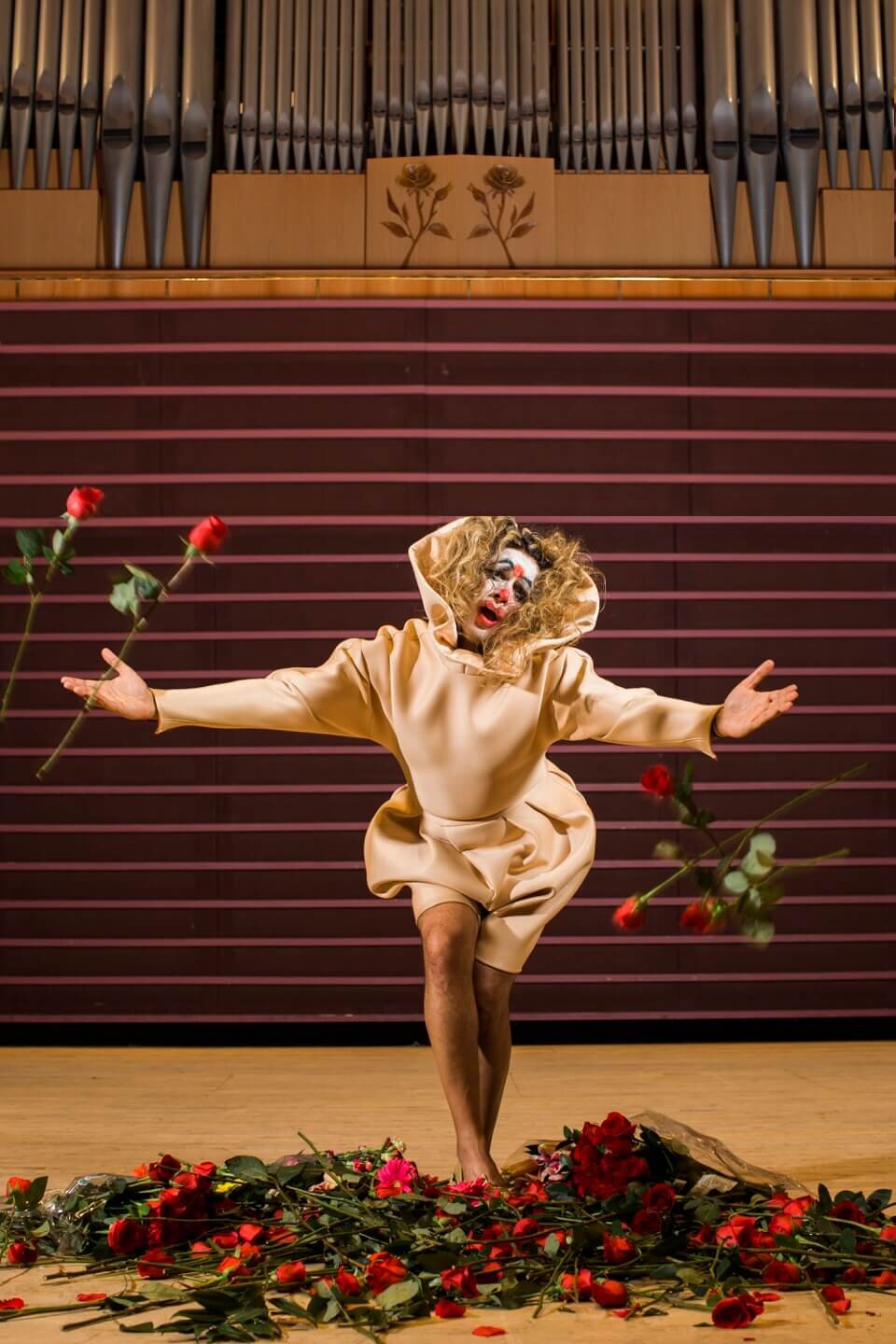
From the first image, Lovesick Clown, where a forlorn Shraya plays her guitar onstage, her makeup and hair become more and more chaotic and outrageous, until we see her in full sad-clown face, miming her pain, with a sea of red-pink roses, thrown by an unseen audience, at her feet. 

“If you could see all these people literally throwing flowers at me!” the affable artist says with a laugh over the phone from her home in Calgary, where she is an assistant professor of creative writing. “Surprisingly it was a lot of fun to do—because I don’t understand what the parameters are for visual art. I don’t know what Heather’s Pick is for visual art. 

“A lot of my brand is tied to how I look, and there’s pressure to present a high femme persona,” Shraya adds. “This is the opposite: something that’s not invested in being pretty. Part of me was playing a character I don’t get to play, and playing that character in a hyperbolic way.”

As fun as it may have been to shoot, the photo series had far more serious inspiration. It came to Shraya as she was touring and performing readings during the wave of success that met her 2018 nonfiction book I’m Afraid of Men—a story of how masculinity was imposed on her as a boy, drove the bullying she received for being queer and nonwhite as a teen, and continues to haunt her as a woman. 

“It wasn’t an easy book to write,” she says of the national bestseller. “It was traumatic, in a way, to go back to those experiences. I found myself tracking how much trauma I was showing in my work and how it was being received. And I saw that the more trauma I exposed publicly, the more there seemed to be support, not just on the audience level but institutional level.”

It was around that time that she casually half-joked in conversation with a friend over the phone that she was becoming a “trauma clown”. 

And so the self-portrait project began to take shape, working with collaborator Ayotte and makeup artist Alanna Chelmick. She knew just what outfit to pull out of her closet: L’Uomo Strano designer Mic. Carter’s high-fashion, neoprene number that happens to have a slightly clownlike frilled collar and playful shorts instead of a skirt. The costume slowly reveals its true splendour over the course of the series. The flowers became the colourfully potent symbol for the Trauma Clown’s rising popularity, growing from three in the first shot to the small mountain in the sixth.

Its approach might rely on exaggeration, but the series ties directly into Shraya’s own trajectory—from her beginnings in music, to the early artistic output alluded to in Coming Out Clown and Immigrant Clown, to her full celebration as a bestselling author. At the same time, the photos address the viewer directly, making us question our own appetite for work that reveals the oppression or suffering of others—especially marginalized others—and the way that’s been commodified.

It’s not Shraya’s first foray into photography and self portrait. “Trisha”, her acclaimed 2016 series of diptychs, mined equally personal ground, picturing Shraya dressed up to re-enact vintage photographs of her beloved mother.

Those artworks could be looked at singularly or out of order, she points out, but she prefers you see “Trauma Clown” in the chronology on the SUM walls. 

Meanwhile, in her own career, she continues to push for the freedom to write about subjects outside of her darker experiences as a trans woman.

“Marginalized artists should have the right to choose to write what they want,” she says, adding she met with resistance when she tried to shop a children’s book about raccoons. “To support diverse voices, it means we have to support what these diverse voices want to say.”

For Shraya, whose debut theatrical work, the semi-autobiographical How to Fail as a Popstar, was just published by Vancouver’s Arsenal Press, she won’t shy away from baring herself altogether anymore. But she questions herself more about it. “I ask myself, ‘Am I feeling pressure to do this?’” she says. “I’m trying to figure out, if I’m disclosing something traumatic, why I’m doing it.” 

Click here to view the original article in full.

Cultivate Artist Circles

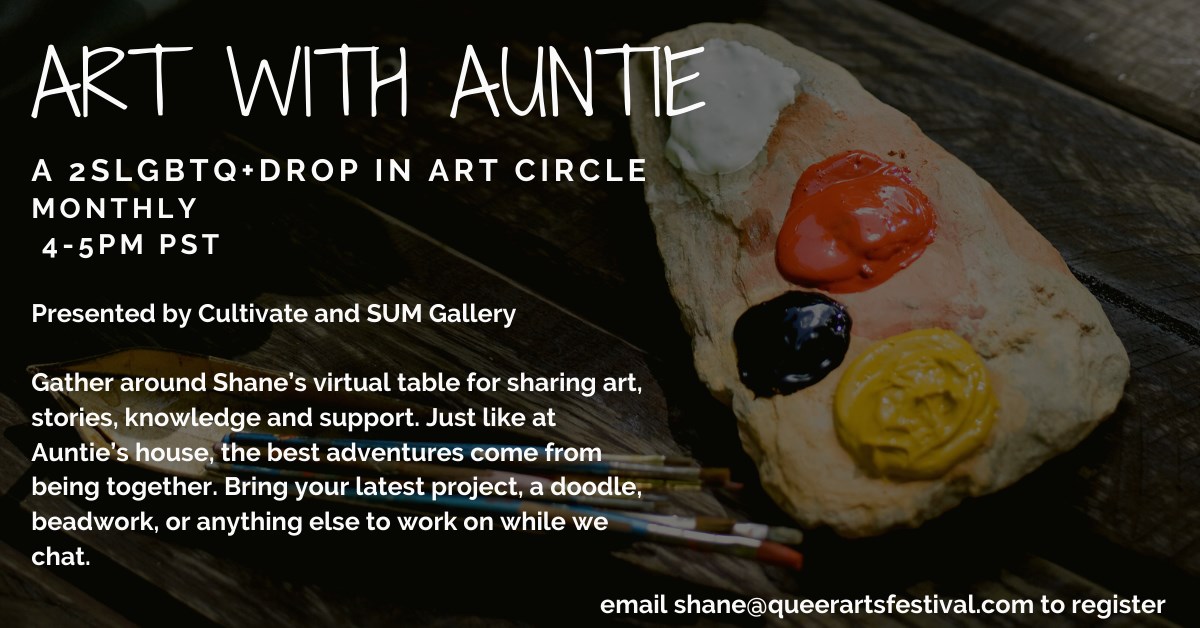
Cultivate presents Art with Auntie, a Queer Drop-In Art Circle

Alternating Wednesdays 4-5pm

Since we can’t gather in person, gather around Shane’s virtual table for sharing art, stories, knowledge and support. Just like at Auntie’s house, the best adventures come from being together. Bring your latest project, a doodle, beadwork, or anything else to work on while we chat. Maybe Auntie will share a story or teach you to make some tea. You’re invited to talk about your art making process, lead a short skills share, and just enjoy being together. 

Community Agreements

Confidence: What’s Said Here Stays Here.

Sharing: What’s Learned Here Leaves Here.

Respect: Everyone gets an opportunity to speak without judgement and without disruption.

Learning: Listen More Than You Speak, and speak with care.

Accountability

Those individuals struggling to uphold the community agreements will be asked to leave the session and will be invited to a private discussion.

Registration process

Send a registration request to shane@queerartsfestival.com and introduce yourself. Zoom link will be emailed shortly before the session. Please do not share the link.

BC Gay and Lesbian Archives photo identification project

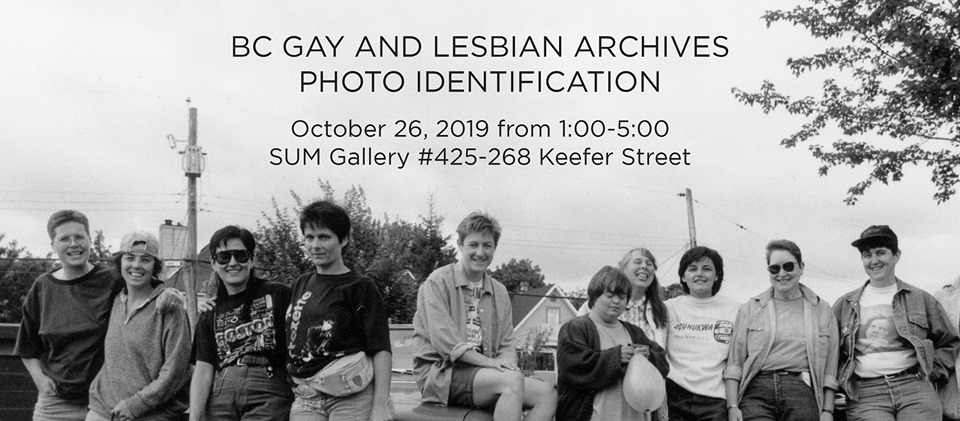
The BC Gay and Lesbian Archives (BCGLA) is a diverse collection of LGBTQ2+ history, started by Ron Dutton in 1970s and recently donated to the City of Vancouver Archives. Of the over 5,400 images that have been digitized, about 1,000 photographs depict people and events that are currently unidentified.

In partnership with the SUM Gallery, the City of Vancouver Archives is asking for help to identify these people and events in the BCGLA photo collection. Spanning from the 1940s to the 2000s, capturing moments from drag performances to City Hall protests, these photos tell the story of a long and powerful history of LGBTQ2+ resistance, solidarity, and strength.

Join us to look through these photos and by sharing your stories, enhance access to this collection. This photo identification event is free and open to the public.

An Interview With Justin Ducharme & Zachery Longboy

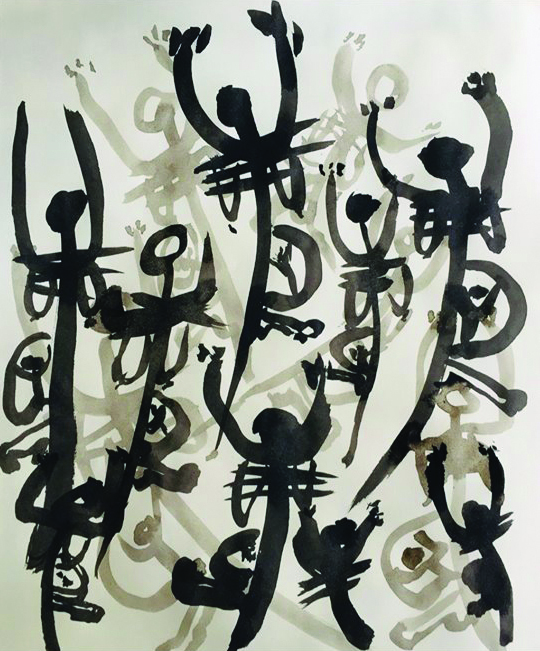
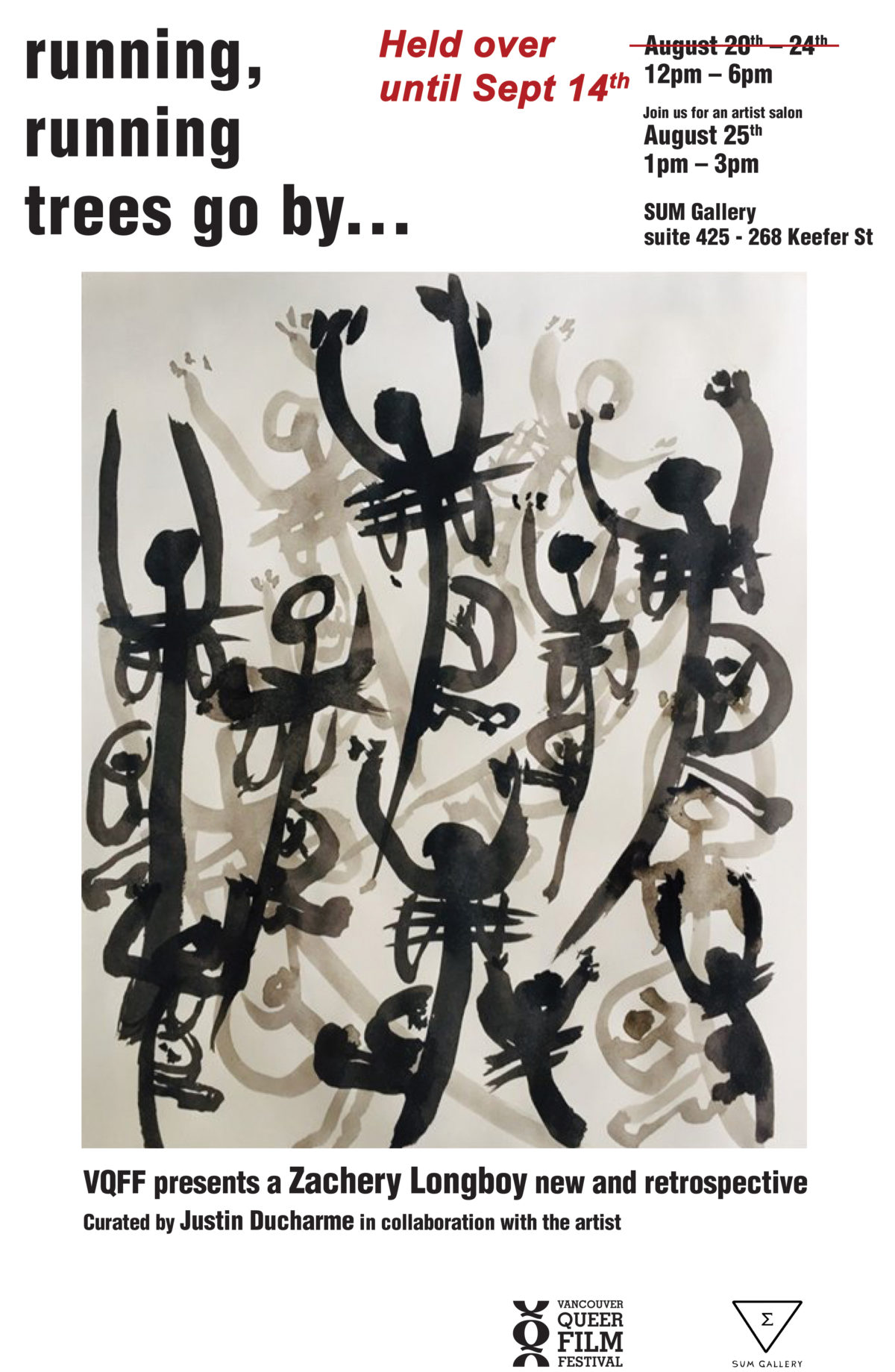
The pop up exhibition running, running, trees go by… shows at SUM Gallery from August 20-25 during the 2019 Vancouver Queer Film Festival. Curated by Festival Programmer Justin Ducharme, it features new and retrospective works by Zachery Longboy.

Longboy is from Churchill, Manitoba and is of Sayisi Dene lineage. The collection continues the artists’ exploration within a fractured cultural experience through deeply felt layered videos, paintings and archival film.

Justin Ducharme (JD) and Zachery Longboy (ZL) talk to SUM Gallery about the exhibition:

Justin, what draws you to Zachery Longboy as an artist and made you want to exhibit his work?

JD: I first saw water into fire, a film by  Zachery a few years ago when I was about 20 years old and I was instantly drawn to the performance aspect of the piece. The work was self reflective on his identity has an indigenous man living with HIV and there was this unfiltered approach to his making that I was instantly drawn to. I discovered Zachery around the same time I became familiar with Thirza Cuthand’s work and I admire the way they both approached filmmaking from both a performance and technical angle. I knew I was going to be making work myself as an artist that is self reflective of my intersecting identities so finding folks who were doing that in ways that felt completely new to me meant a lot. Most of my film work is narrative based but I’ve drawn heavily from people like Zachery and Thirza who have made performative documentary work. Kinship and community is a huge part of why I am where I am as a creator and human being. I can say 100% with my gut that I would not be the artist or person I am without my kin or artists like Zachery. 

Zachery, what made you trust Justin and embark on this collaboration? Were you actively pursuing exhibition opportunities or was there a particular calling that brought you to SUM?

ZL: There was no reason not to trust Justin, I had been thinking about pursuing an exhibition; however, never got beyond the thinking. I have always enjoyed collaboration and this has been the perfect opportunity to work with the Vancouver Queer Film Festival, SUM Gallery and Justin. He had a clear vision of how he saw my work presented and what it meant to him. I drew these works over the last 2 years and there is a movement that flows through all: community, difference, search for belonging and acceptance. I began animating the drawings and posting them on Instagram. That’s where Justin saw the work. 

How did you select the works? All of the pieces are new except for the stone show although it too has been reimagined. What is the artistic statement behind these new pieces? What do you hope people take away from the show?

JD: We selected the works over the course of one afternoon back in July.  It was pretty chill how it all came about. We started by talking about healing actually, cuz I was going through some shit and we mutually bonded over our sad boi identities. I thought about colour palette first because Zachery has such an expansive collection of drawings and paintings. We both connected to the greyscale black and white works and knew we wanted to keep the majority of pieces in the exhibit that tone.  

ZL:  We decided early on that the work had to stand for itself, circumventing the traditional title and explanations cards. Let the viewer enjoy and experience the work without the clutter of explanation.

JD: We talked a lot about trusting our audience.  It was kind of fitting that the theme of VQFF this year is See for Yourself because that is exactly what we are asking people to do. Something Zachery and I both love is showing someone something and then allowing them to discuss what it means to them or how it makes them feel. We didn’t want to spoon feed a narrative to anyone. Come and be immerrsed in the work and draw from it what you will. We both connect to the peices in there for different reasons and that’s the beauty of it I think. 

There are no title cards for the pieces – is there a story behind why that is? Does this create a barrier between the viewer and the art or does it allow for a more personal relationship to the pieces? 

JD: I personally don’t think it creates a barrier for people to connect to the pieces. Something I have been struggling with lately is this whole idea of having to name something when it’s finished. We have titles and terms for so many different things in the english language and it’s just not like that in most indigenous languages or others for that matter. Sometimes there are no words for things, and that is okay. 

The stone show has been revisited – cut from an hour of original footage down to a fifteen minute video. What motivated this? Has the piece become something different through its reconstruction?

JD: Mainly obsession. I desperately wanted to include an archival piece in the exhibit and we talked for a bit about what that would look like.  I had seen the orignal hour long show via footage from grunt gallery and was so connected to the visuals and spoken word aspect of the piece. Being a filmmaker myself I was up for the challenge of giving it a recut and suggested it to Zachery after grunt let me know they had the VHS footage available. For me it now feels like a cinematic love letter to knowing but not knowing who you are and where you come from. The spoken word aspect, the physicality of the piece, everything was so incredibly emotion inducing.  

Justin, you work as a festival programmer for Vancouver Queer Film Festival. Is there a particular film at this year’s festival that you can recommend which speaks to this exhibition? 

JD: Yes I can think of one in particular that I’d like to shout out. Wildfire by Bretten Hannam is a short film that is screening on Friday, Aug 24th at The York Theatre in a shorts program I curated titled all our relations: explorations on indigiqueer kinship. The film follows two Mi’kmaw teens on the run from one of their abusive stepfathers and lets the viewer see how their kinship grows through this experience. When I think of running running trees go by… I think about the journey Zachery and I took together, I think about movement, about community, about pain and longing, about kinship. I think Wildfire discusses these themes in a way that is so singular to Brettens filmmaking, so while I don’t think the comparison necessarily slaps you across the face right away I think that if you dig deep you might find something you didn’t see before.

running running trees go by…

Curated by Justin Ducharme in collaboration with the Artist… this year’s Festival offers a pop-up exhibit featuring new and retrospective works from artist Zachery Longboy.

Longboy is from Churchill, Manitoba and is of Sayisi Dene lineage. This new and retrospective collection continues the artists’ exploration within a fractured cultural experience through deeply felt layered videos, paintings and archival film.

This exhibit has been held over until September 14.